Kamis, 31 Januari 2019

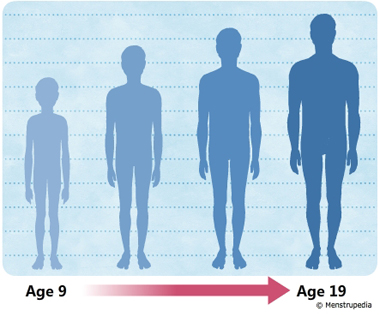
Development of adolescent boys

Developmental Milestones

This is a time of changes for how teenagers think, feel, and interact with others, and how their bodies grow. Most girls will be physically mature by now, and most will have completed puberty. Boys might still be maturing physically during this time. Your teen might have concerns about her body size, shape, or weight. Eating disorders also can be common, especially among girls. During this time, your teen is developing his unique personality and opinions. Relationships with friends are still important, yet your teen will have other interests as he develops a more clear sense of who he is. This is also an important time to prepare for more independence and responsibility; many teenagers start working, and many will be leaving home soon after high school.
Here is some information on how teens develop:

Hasil gambar untuk Development of adolescent boys

growth of male adolescents

The Growing Child: Adolescent (13 to 18 Years)


Hasil gambar untuk growth of male adolescents


How much will my adolescent grow?

The teenage years are also called adolescence. Adolescence is a time for growth spurts and puberty changes. An adolescent may grow several inches in several months followed by a period of very slow growth, then have another growth spurt. Changes with puberty (sexual maturation) may occur gradually or several signs may become visible at the same time.


There is a great amount of variation in the rate of changes that may occur. Some teenagers may experience these signs of maturity sooner or later than others.


Sexual and other physical maturation that occurs during puberty is a result of hormonal changes. In boys, it is difficult to know exactly when puberty is coming. There are changes that occur, but they occur gradually and over a period of time, rather than as a single event. While each male adolescent is different, the following are average ages when puberty changes may occur:
  • Beginning of puberty: 9.5 to 14 years old
  • First pubertal change: enlargement of the testicles
  • Penis enlargement: begins approximately one year after the testicles begin enlarging
  • Appearance of pubic hair: 13.5 years old
  • Nocturnal emissions (or "wet dreams"): 14 years old
  • Hair under the arms and on the face, voice change, and acne: 15 years old
Girls also experience puberty as a sequence of events, but their pubertal changes usually begin before boys of the same age. Each girl is different and may progress through these changes differently. The following are average ages when puberty changes may occur:
  • Beginning of puberty: 8 to 13 years
  • First pubertal change: breast development
  • Pubic hair development: shortly after breast development
  • Hair under the arms: 12 years old
  • Menstrual periods: 10 to 16.5 years old
There are specific stages of development that both boys and girls go through when developing secondary sexual characteristics (the physical characteristics of males and females that are not involved in reproduction such as voice changes, body shape, pubic hair distribution, and facial hair). The following is a brief overview of the changes that occur:
  • In boys, the initial puberty change is the enlargement of the scrotum and testes. At this point, the penis does not enlarge. Then, as the testes and scrotum continue to enlarge, the penis gets longer. Next, the penis will continue to grow in both size and length.
  • In girls, the initial puberty change is the development of breast buds, in which the breast and nipple elevate. The areola (dark area of skin that surrounds the nipple of the breast) increases in size at this time. The breasts then continue to enlarge. Eventually, the nipples and the areolas will elevate again, forming another projection on the breasts. At the adult state, only the nipple remains elevated above the rest of the breast tissue.
  • Pubic hair development is similar for both girls and boys. The initial growth of hair produces long, soft hair that is only in a small area around the genitals. This hair then becomes darker and coarser as it continues to spread. The pubic hair eventually looks like adult hair, but in a smaller area. It may spread to the thighs and, sometimes, up the stomach.

What does my adolescent understand?

The teenage years bring many changes, not only physically, but also mentally and socially. During these years, adolescents increase their ability to think abstractly and eventually make plans and set long-term goals. Each child may progress at a different rate and may have a different view of the world. In general, the following are some of the abilities that may be evident in your adolescent:
  • Develops the ability to think abstractly
  • Is concerned with philosophy, politics, and social issues
  • Thinks long-term
  • Sets goals
  • Compares one's self to one's peers
As your adolescent begins to struggle for independence and control, many changes may occur. The following are some of the issues that may be involved with your adolescent during these years:
  • Wants independence from parents
  • Peer influence and acceptance becomes very important
  • Romantic/sexual relationships become important
  • May be in love
  • Has long-term commitment in relationship

How to assist your adolescent in developing socially

Consider the following as ways to foster your adolescent's social abilities:
  • Encourage your adolescent to take on new challenges.
  • Talk with your adolescent about not losing sight of one's self in group relations.
  • Encourage your adolescent to talk to a trusted adult about problems or concerns, even if it is not you he or she chooses to talk with.
  • Discuss ways to manage and handle stress.
  • Provide consistent, loving discipline with limits, restrictions, and rewards.
  • Find ways to spend time together.